A true story, 1900–1980
The life of Theodor Tokarenko
This is the life of Theodor Tokarenko, told as a story. Everything here comes from archival records, newspapers and the memories of two families. Where we don't know what Theodor himself saw or felt, we tell what his fellow travellers described in the same weeks. Nothing has been made up.
Kharkiv · 1900
A boy of the railway
Theodor is born in a country that still has a tsar. In Kharkiv it is 5 February 1900, by the Russian calendar. In the rest of Europe it is already 17 February. Thirty years later, when he becomes Dutch, he still writes down both dates.
His father, Viktor Pavlovich Tokarenko, works for the railway. That is a good job in Kharkiv, one of the great railway cities of the Russian Empire, where the lines to Moscow, Crimea, the Donbas coal mines and the Black Sea meet. His mother is called Theodora, daughter of a certain Grigori. We know nothing more about her. She dies before her son marries.
Theodor is Roman Catholic, in a city where nearly everyone is Orthodox. What his childhood was like, where he lived, whether he had brothers or sisters: nobody remembers any more.
Kharkiv · 1917–1919
Red one day, White the next
Theodor is seventeen when the revolution breaks out. Then war comes to his own city. Kharkiv changes hands again and again. One day the Reds hold the city, the next day the Whites. Whoever belongs to the wrong side is arrested or shot.
Then come the diseases: typhus, spread by lice, and smallpox. There are no doctors left and no medicine. Houses are disinfected with paraffin. People wait for days at stations for a train that doesn't come, and the dead lie among them.
In Kharkiv there is a Dutchman trying to save what can be saved: consul Alphons Uchtman, an engineer. Because the Netherlands is neutral, he also looks after Poles, Belgians and French. He sends seventeen trains of refugees and prisoners of war to the Black Sea. He catches typhus himself, and survives.
Theodor has a friend: Kees van den Muyzenberg, son of the Dutch director of a salt mine near Bakhmut. They are almost exactly the same age. How they met we don't know. But that friendship is going to save his life.
December 1919
Out of Kharkiv
On 12 December 1919 the Red Army marches into Kharkiv. The Whites flee south, to the Black Sea, and tens of thousands of civilians with them. Anyone who still wants to get out must go now.
Theodor gets a Polish passport, number 3369, dated Kharkiv, 2 January 1920, probably through consul Uchtman, who looks after Polish interests. On paper Theodor is no longer a Russian but a Pole, a foreigner who is allowed to leave.
At the salt mine, six people leave in the dark in the night of 22 to 23 December: director Van den Muyzenberg, his son Kees, engineer Cornelius Marx and three others. For ten days they drive by horse and cart across the winter steppe to Rostov. On the way they sleep in farmhouses with typhus. Retreating Cossacks rob whoever they meet.
Theodor is probably not with them but in consul Uchtman's wagon, which leaves Kharkiv full of ‘family and acquaintances’. In Rostov the groups come together. The Van den Muyzenberg family later wrote down that the young Russian Theo Tokarenko, Kees's friend, went with them.
Rostov – Novorossiysk · January 1920
Thirty-six people in a freight wagon
In Rostov, Uchtman arranges a freight wagon. Thirty-six people get in, and half the wagon is filled with luggage. There is no heating, no toilet, no light. For three days they stand at the station in wind and cold, waiting for a locomotive. Rostov is a city in panic. In the Van den Muyzenberg family's memory, bodies hang from the lampposts.
At last the wagon is coupled to a train to Novorossiysk. The next morning Rostov falls to the Bolsheviks. They got out just in time.
Nothing works any more. Broken wagons and locomotives are shunted onto sidings and never repaired. To fire the locomotive, sleepers are torn up from the sidings and, according to the Van den Muyzenberg family, telephone poles too. The driver always carries an axe.
On the second day they discover that their wagon has been uncoupled in the middle of the steppe, between two stations. A few profiteers bribed the driver to go on without the rest. The Reds are coming closer. The station master refuses to help. Only with a lot of money, and in the end with threats, do they get moving again.
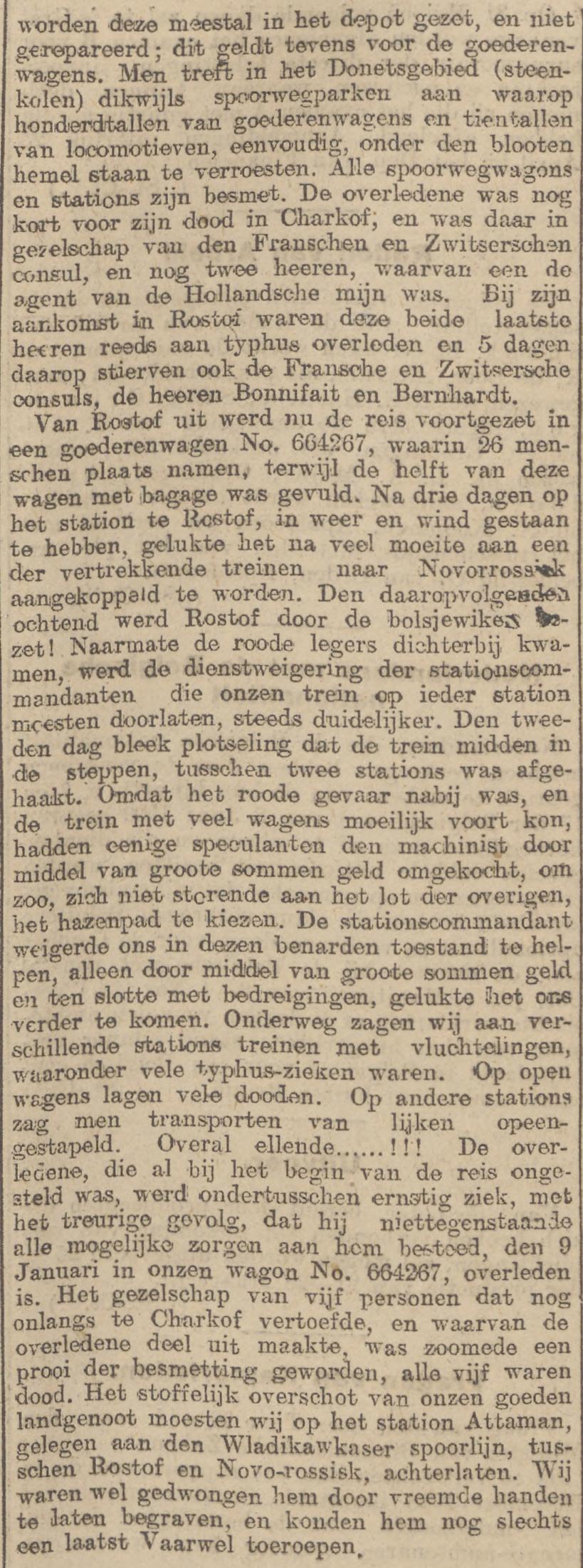
Along the line the group sees what Uchtman later describes in the newspaper. Everywhere stand trains full of refugees, full of typhus patients. On open wagons lie the dead, frozen, with no one left to bury them. At other stations bodies are piled up to be carted away. In the Tokarenko family it was later told like this: he fled ‘by train and freight wagons among sick and dead people’.
“On the way we saw at various stations trains with refugees, many of them sick with typhus. On open wagons lay many dead.”
9 January 1920
Left behind at Ottomanskaya station
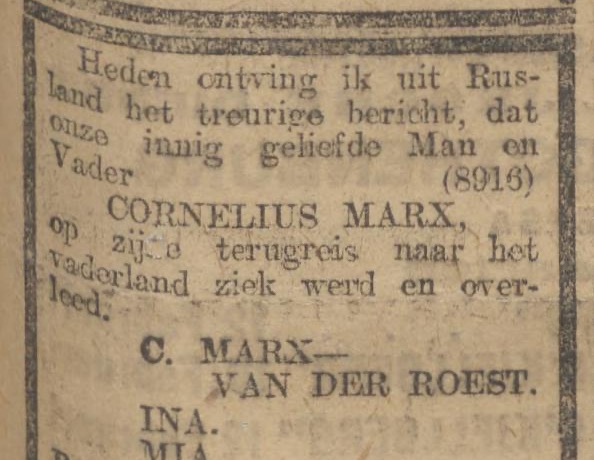
Engineer Cornelius Marx is already ill when the journey begins. In the wagon he gets worse. On the evening of 9 January 1920 he dies, right among the others, in the wagon. He is in his mid-thirties. Of the group of five he was with in Kharkiv shortly before, no one is still alive.
They cannot take him along. The train has to go on. Director Van den Muyzenberg manages to hold the train for a few hours. They leave the body at Ottomanskaya station, on the railway to the Caucasus, to be buried by strangers.
Four weeks later, on 6 February, his wife in Bussum opens a message from Russia. She puts a notice in the newspaper that her husband ‘fell ill on his journey home and died’.
Novorossiysk – Constantinople – Marseille · 1920
Across the sea
Novorossiysk is a harbour full of desperate people. Everyone wants a place on a ship, and those without money, papers or connections are left behind. Weeks later there is a panicked evacuation here. The group gets on a French boat to Constantinople.
In Constantinople, occupied by the Allies and flooded with Russian refugees, they stay a few weeks. Here Theodor receives his first visa. Then by boat to Marseille. The railways are on strike there, and a military train takes them to Paris. Two days later they travel north through Belgium.
On 6 March 1920 they arrive in Roosendaal. Theodor is twenty. He has a Polish passport, probably no money and probably not a word of Dutch. His father and everything he knew lie thousands of kilometres behind him. As far as we know, he never saw them again.
Bloemendaal · Blaricum · Amsterdam · 1920–1926
A room above the barber's
His first address is in Bloemendaal, on Verbindingsweg, where consul Uchtman has a house. Six weeks later he moves to Blaricum, the village where his friend Kees lives. He rents a room with barber Post on Angerechtsweg and goes to work for Schutte, an electrical firm looking for fitters. Here he learns the trade he will practise for the rest of his life.
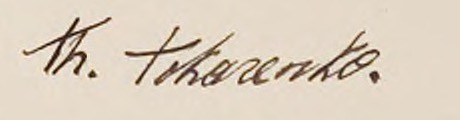
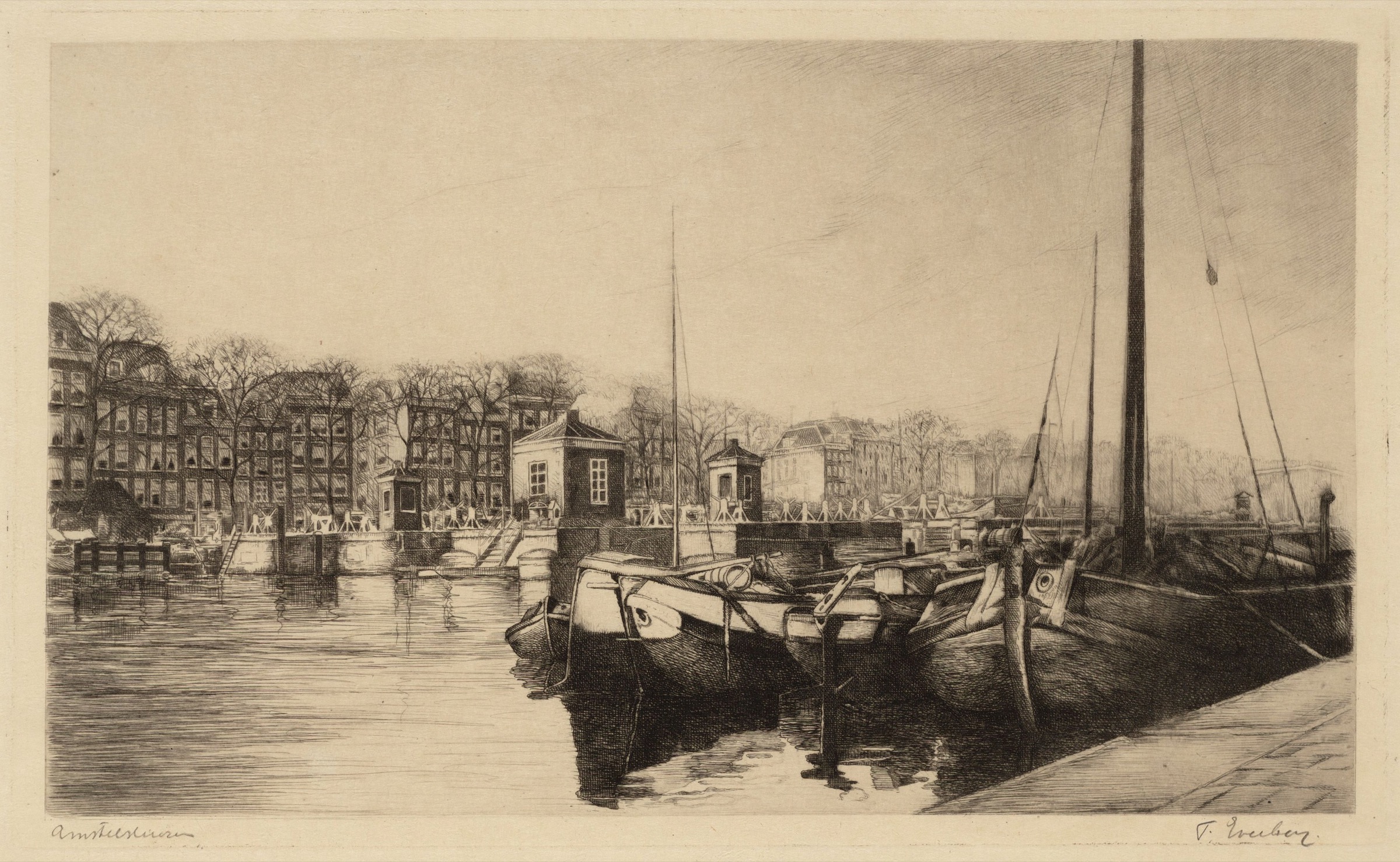
In October 1921 he reports to the aliens police in Amsterdam. They note him down precisely: height 1.60 metres, blond hair, brown eyes, Roman Catholic. He signs: Th. Tokarenko. His address is Amstel 300, with Uchtman, and he works there too. In July 1922 Uchtman founds his own installation company at that address, opposite the Carré theatre. The company still exists. Theodor has to have his residence papers renewed again and again.
Bussum · Hilversum · 1926–1935
Dutchman
In 1926 he moves to Bussum. He is an electrician, and these are the years of radio. On 9 July 1931 he becomes Dutch by act of parliament. The explanatory note says briefly: of Russian origin, earns his living as an electrician, engaged to a Dutch woman.
On 10 August 1932 he marries Gijsberta van Putten in Hilversum, twenty-six, daughter of a late father from the Gooi. The marriage certificate states that his own father, Viktor Pavlovich, is still alive, in Kharkiv. His mother has died. His own family is far away. That winter a famine breaks out in Ukraine that costs millions of lives. Whether his father survived it, we don't know.
On 28 June 1935 his son is born. He is named Victor, like his grandfather in Kharkiv. That same year Theodor plays football in the team of the Bussum radio relay company.
Hilversum · 1940–1966
The chessboard
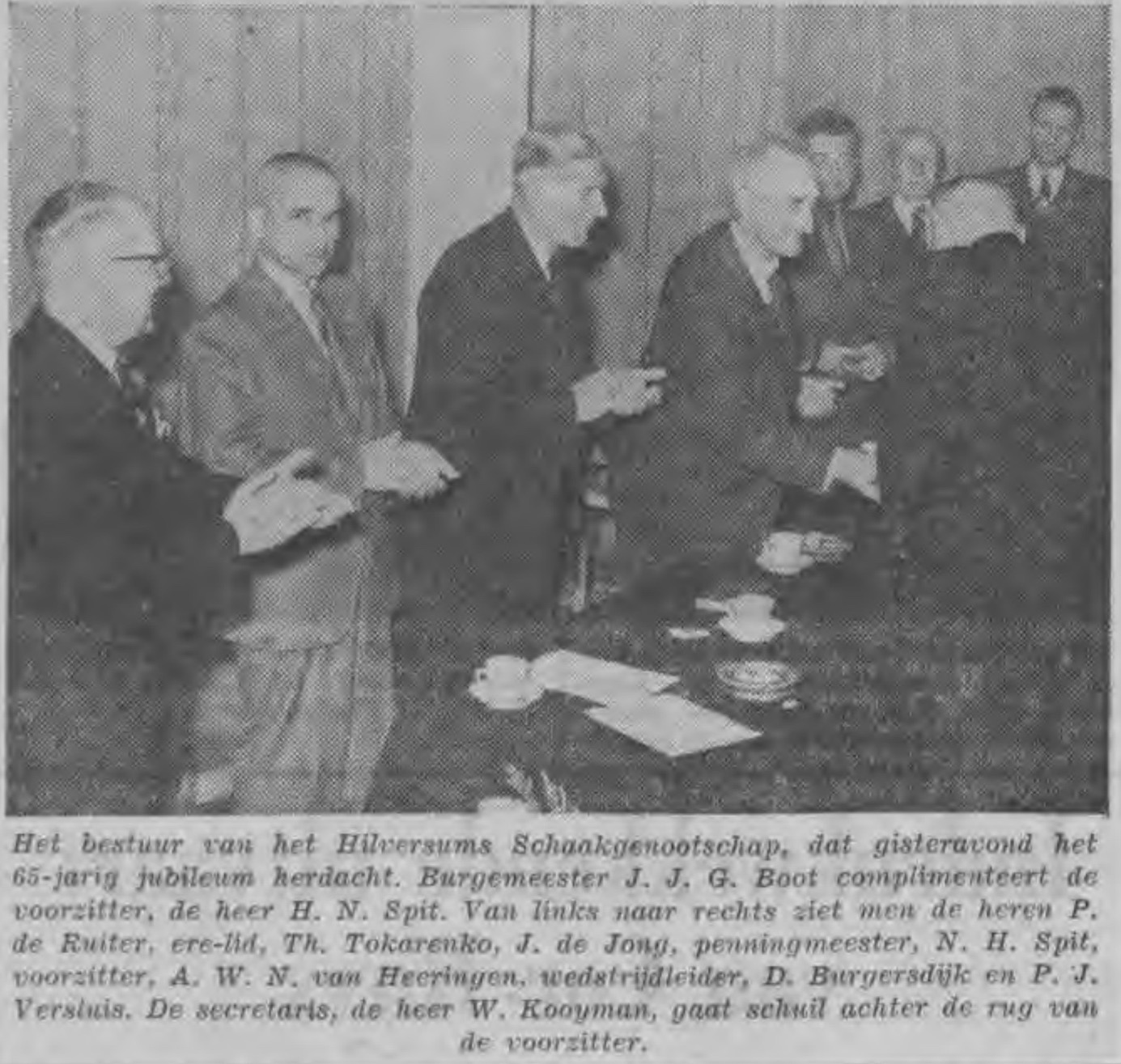
From February 1937 the family lives at Van Oldenbarneveltlaan 24 in Hilversum, where Theodor stays for the rest of his life. Of the war years we know little: in 1942 the directory lists him as head mechanic, and in 1943 he pays ƒ 6.70 in ‘zoengeld’, a levy of the occupation years. After the war he turns up in the paper, always at the chessboard. He plays for the Hilversum Chess Society, first in the lower divisions, later on the board. In the photo of the 65th anniversary in 1952 he stands second from the left.
On Sunday 27 December 1959 two Soviet grandmasters land at Schiphol: Tigran Petrosian, the future world champion, and Salo Flohr. Their first stop is Hilversum, where 153 players are waiting. On behalf of the club, Theodor addresses them, in Russian. Forty years after the freight wagon, he speaks his mother tongue again, to men from the country he fled.
His working life is at N.V. Diode, an electronics laboratory in Hilversum, where he becomes head mechanic. In July 1966 he receives the bronze medal of the Order of Orange-Nassau. The refugee with the Polish passport has become a decorated Dutchman.
“Th. Tokarenko of Hilversum, a board member of the chess society who comes from Russia, gave both grandmasters a warm welcome in their own language.”
Hilversum · 7 February 1980
Ten days before his eightieth
Theodor Tokarenko dies in Hilversum on 7 February 1980, ten days before his eightieth birthday. In August his widow Gijsberta sends the medal back to the Chancellery.
What remains are a few lines in a register, a signature, a newspaper photo and a family story about a hellish journey in a freight wagon, among the sick and the dead. And somewhere in Kharkiv, or perhaps in Lublin, a baptism register with his name in it that no one has found yet.